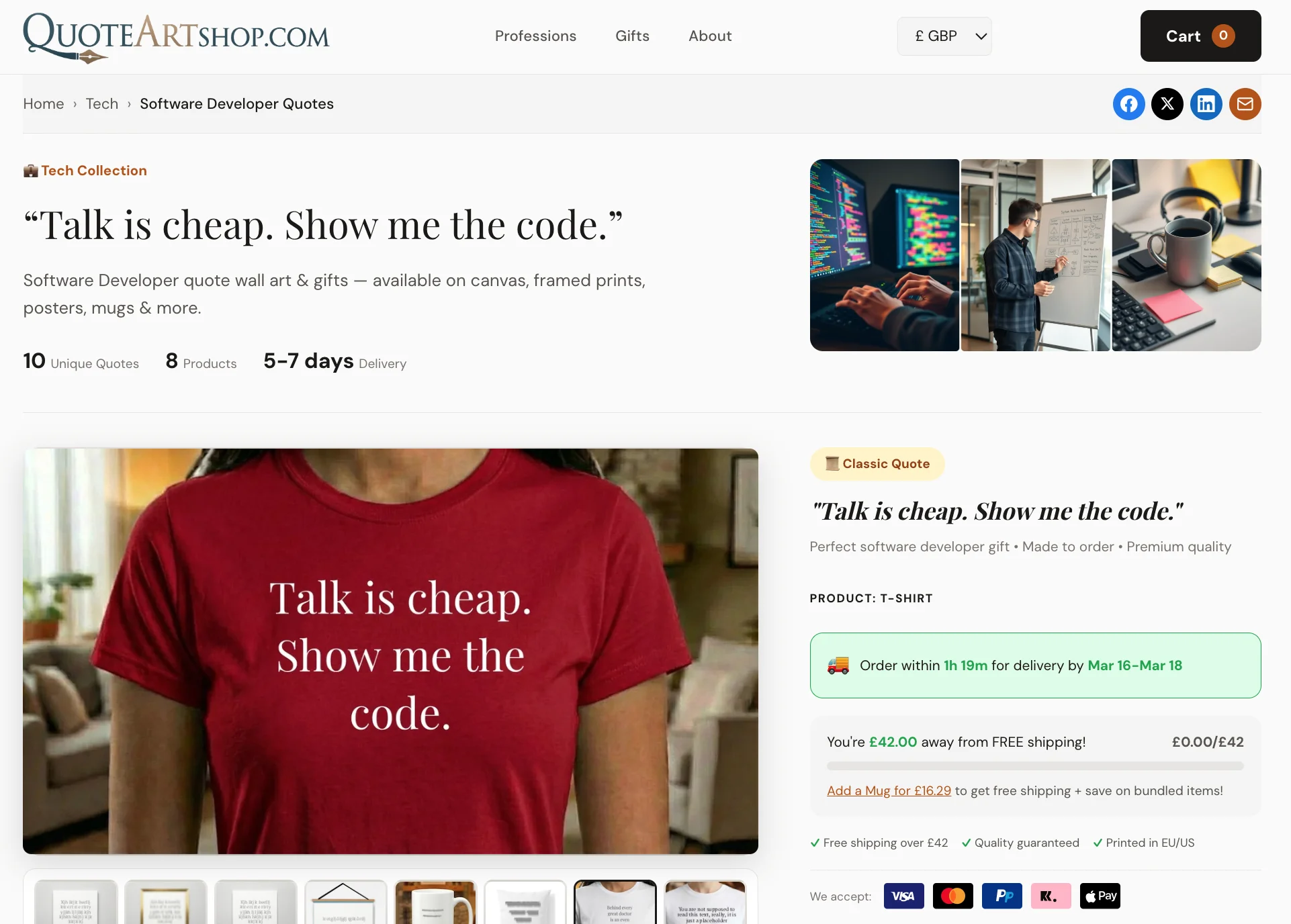
Most business owners judge their website by how it looks in the browser. But what Google sees is often something entirely different. We discovered that 484 product pages on one of our e-commerce sites were essentially blank to search engines — despite looking flawless to visitors.
The problem: A blank page with a pretty cover
Imagine opening a product catalogue. Every page has an image, a description, and a price button. Everything looks great.
But if you could see the page through Google's eyes, you would see something very different: a blank page with three empty boxes. No image. No text. Nothing to index.
That is exactly what happened with one of our online stores with hundreds of product pages. Every page was built using a technique that filled in the content after the page loaded — using JavaScript. It worked perfectly for visitors. But Google typically only reads what is in the page's source code, before JavaScript gets a chance to run.
The result? Google saw hundreds of pages that all looked the same: empty. And empty pages that look identical are interpreted by Google as duplicate content — something that actively lowers your visibility in search results.
Why this is more common than you think
This is not an unusual mistake. Many modern websites are built with frameworks that render all content via JavaScript. It provides a smooth user experience — the page feels fast and interactive.
But it creates a fundamental problem: what your customers can see is not necessarily what Google can see.
Google can technically run JavaScript, but:
- It takes more time and costs Google resources
- There is no guarantee that all content will finish loading
- Pages that require JavaScript end up in a separate rendering queue — and that queue can be long
This means your polished product page might be indexed as a blank page. Or not indexed at all.
The same problem applies to AI search
This is not just about Google. AI tools like ChatGPT, Perplexity, and Google AI Overviews also fetch content from web pages. They read the source code — not what JavaScript draws on screen.
If your page is empty without JavaScript, it is invisible to AI search as well. And AI search is growing rapidly as a traffic source.
The solution: Serve real content from the start
We fixed the problem by changing how the product pages are built. Instead of sending an empty template for JavaScript to fill in, the server now delivers a complete page straight away:
- The product image is in the source code with a permanent URL that Google can index
- Product thumbnails are real images with descriptive alt texts
- The first quotes are readable text directly in the page's HTML
Visitors notice no difference — the page looks the same and is just as interactive as before. But Google now sees a unique, content-rich page for every product. 484 blank pages became 484 unique pages with images, text, and metadata.
The interactive parts — changing size, choosing style, adding to cart — are still handled by JavaScript. But the core content is already in place before any script runs.
How do you know if your site has the same problem?
A simple test: right-click on your website and choose "View Page Source". If you can see your product names, descriptions, and images directly in the code — good. If you see empty boxes and lots of JavaScript — you may have the same invisibility problem.
You can also use Google's own URL Inspection tool in Search Console to see exactly what Google sees when it visits your page.
Looking good is not enough
A website has two audiences: your customers and search engines. If you only optimise for one, you miss the other.
Many agencies and developers build sites that look fantastic in the browser but are half-empty to Google. It is like having a shop with perfect interior design — but with the curtains drawn facing the street.
A technically well-built website works for everyone: visitors, Google, and the AI tools that more and more people use to find products and services.
Want to know if your website is visible to Google and AI search? Get in touch for a technical SEO audit.