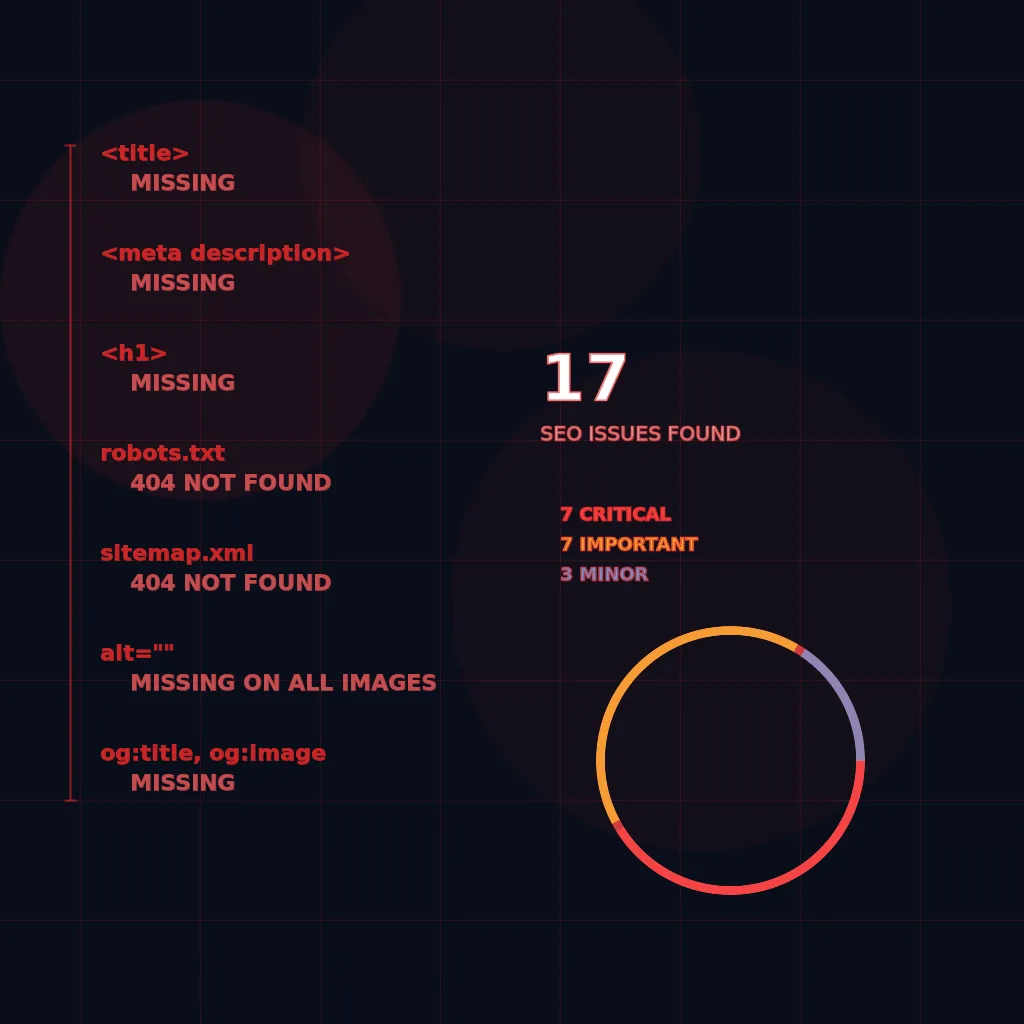
How hard can it be to get basic SEO in place? We picked a random Swedish e-commerce site and ran a quick audit. Ten minutes later we had found 17 problems — 7 of which were critical. This is not an attack on the site in question. It's a reminder of how easy it is to miss the basics.
Background: a small retro shop
The site we audited is a small e-commerce site selling retro items — tin signs, mugs, Betty Boop figurines and the like. It's built with one.com's website builder and hosts its products through their integrated webshop solution.
It's a typical small online store. The owner has presumably focused on getting products and payments up and running — and SEO has ended up at the bottom of the list. That's understandable. But it also means the site is essentially invisible in Google for all searches except its own brand name.
The critical findings
Missing title tag
The title tag is the single most important SEO element on a page. It's what appears as the heading in Google's search results. This site was missing a proper title tag on the homepage. It's like opening a store without a sign above the door.
The fix is simple — one line of HTML:
<title>PeWeCo Retro Shop - Tin Signs, Mugs & Retro Products</title>Missing meta description
Without a meta description, Google chooses which text to display below the heading in search results. Sometimes it picks copyright text, sometimes a registration number. Not exactly click-friendly.
<meta name="description" content="Buy tin signs, retro mugs and Betty Boop figurines. Fast delivery from Sweden.">No H1 heading
The homepage — the most important page — was completely missing an <h1> heading. Without an H1, search engines have difficulty understanding what the page is about. The "About us" subpage had an H1, but the very page that should be optimized had none.
Broken sitemap
This was the most serious finding. The site had a sitemap index that pointed to a webshop sitemap — but that link returned 404 Not Found. This means Google doesn't have a map of the site's product pages. The working part of the sitemap contained only 3 URLs with lastmod: 2020-09-17 — over five years old.
For an e-commerce site with perhaps hundreds of products, this is devastating. The products aren't indexed, and Google has no idea they exist.
No robots.txt
/robots.txt returned 404. Without this file, search engines can crawl things you don't want indexed, and you miss the opportunity to point to your sitemap.
User-agent: *
Allow: /

Sitemap: https://example.com/sitemap.xml
All images missing alt text
All images on the site — logo, banners, payment icons — were missing the alt attribute. This is bad for SEO (the images don't appear in image search) and for accessibility (screen readers can't describe them).
The important issues
No Open Graph tags
Without og:title, og:description and og:image, shares on Facebook and LinkedIn look dull — no image, no description, no enticement to click. Considering that social media is often the only marketing channel for small e-commerce businesses, this is a big miss.
No structured data
No JSON-LD, no Schema.org. For an e-commerce site, this means Google cannot show price, stock status or reviews in search results. Those rich snippets that make some results stand out? Impossible without structured data.
| Schema type | What it provides in Google |
|---|---|
Product | Price, stock status, reviews |
Organization | Logo, contact info in the knowledge panel |
FAQPage | Expandable questions directly in search results |
BreadcrumbList | Navigation chain instead of URL |
Missing canonical tag
Without <link rel="canonical">, the site risks problems with duplicate content — especially if pages can be reached with and without "www", with parameters, or with and without trailing slashes.
Missing lang attribute
The HTML tag was missing lang="sv". A single line that takes two seconds to add, but helps search engines and screen readers understand that the site is in Swedish.
FAQ page: lorem ipsum
This was perhaps the most embarrassing finding. The page /about-us/faq.html contained six identical questions with placeholder text in English — pure lorem ipsum. The heading was "FREQUENTLY ASKED QUESTIONS" in English despite the site being in Swedish. A page that Google indexes and visitors can find.
Two options: fill in real questions and answers (delivery times, returns, payment methods) or remove the page entirely. Lorem ipsum has no place on a public site.
Minimal navigation and internal link structure
The site had 2–3 navigation links. No category pages in the menu, no terms and conditions, no customer service. Internal link structure is crucial for search engines to discover and understand all pages.
What actually worked
Not everything was bad:
- HTTPS — the site is correctly served over HTTPS
- The site loads — it renders and works technically
- The payment solution seems to work — Visa, Mastercard and Swish
But that's not enough to appear in search results.
Summary: 17 problems in a table
| Priority | Problem | Status |
|---|---|---|
| Critical | Missing title tag | Missing |
| Critical | Missing meta description | Missing |
| Critical | No H1 on the homepage | Missing |
| Critical | No robots.txt | 404 |
| Critical | Broken webshop sitemap | 404 |
| Critical | Outdated sitemap (3 URLs, 5+ years old) | Outdated |
| Critical | All images missing alt text | Missing |
| Important | No Open Graph tags | Missing |
| Important | No structured data (JSON-LD) | Missing |
| Important | Missing canonical tag | Missing |
| Important | Missing lang="sv" | Missing |
| Important | FAQ page with lorem ipsum | Placeholder |
| Important | Minimal internal link structure | 2–3 links |
| Important | No ARIA attributes | Missing |
| Minor | Images not optimized (JPG, no lazy loading) | Not optimized |
| Minor | Extremely little text content on homepage | Minimal |
| Minor | Images hosted externally (extra DNS lookups) | External hosting |
What can we learn?
This is not unique to this site. We see the same pattern over and over with small businesses that build their site with website builders:
- The platform makes it easy to get started — but hides the SEO basics
- Focus ends up on design and products — technical SEO gets forgotten
- Placeholder content gets published by mistake — and nobody notices
- Sitemap and robots.txt "should take care of themselves" — but they don't always
It doesn't take much to fix the basics. Most of the problems we found can be solved with a handful of HTML tags and a correct sitemap. But you need to know they're needed — and that's where many fall through the cracks.
Unsure how your site performs in search engines?
We run the same type of SEO audit on your site — fast, concrete and with clear action items. No fluff, just what actually affects your visibility.
Book a free SEO review